Where Is Your God?

Reading the Word
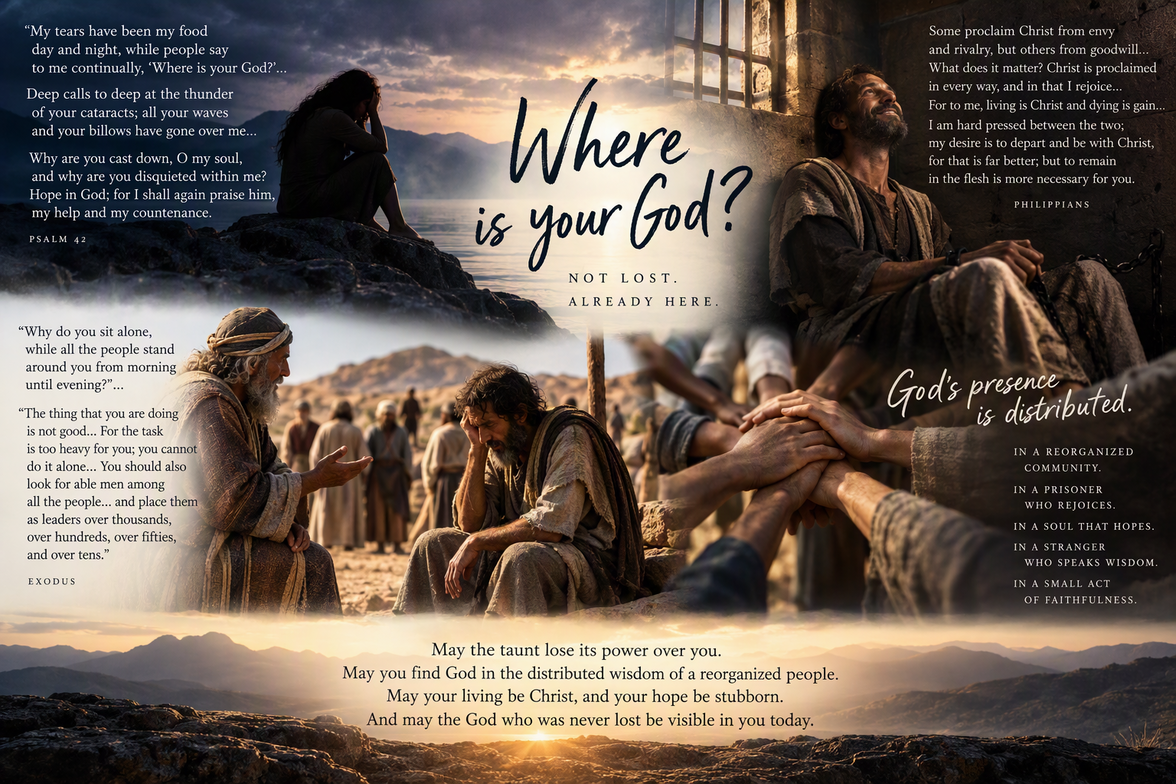
From Psalm 42: "My tears have been my food day and night, while people say to me continually, 'Where is your God?'... Deep calls to deep at the thunder of your cataracts; all your waves and your billows have gone over me... Why are you cast down, O my soul, and why are you disquieted within me? Hope in God; for I shall again praise him, my help and my countenance."
From Exodus: Moses sat as judge for the people from morning until evening. When Jethro saw all that he was doing for the people, he said, "What is this that you are doing for the people? Why do you sit alone, while all the people stand around you from morning until evening?"... "The thing that you are doing is not good. You will surely wear yourself out, both you and these people with you. For the task is too heavy for you; you cannot do it alone... You should represent the people before God, and bring their cases before God. Teach them... You should also look for able men among all the people... and place them as leaders over thousands, over hundreds, over fifties, and over tens. Let them bring every difficult case to you; every minor case they shall judge themselves."
From Philippians: "Some proclaim Christ from envy and rivalry, but others from goodwill. The latter do it out of love... the former proclaim Christ out of selfish ambition, not purely but thinking to afflict me in my imprisonment. What does it matter? Just this, that Christ is proclaimed in every way, whether out of false motives or true; and in that I rejoice... For to me, living is Christ and dying is gain... I am hard pressed between the two: my desire is to depart and be with Christ, for that is far better; but to remain in the flesh is more necessary for you."
Reflection
There is a question that runs through Psalm 42 like a splinter: "Where is your God?"
It is a taunt. The enemies, whether human critics or the darker voice within, keep asking it. Your prayers are unanswered. Your deliverance has not come. You are weeping day and night and still no rescue. Where is your God now?
And here is what strikes me: the psalmist never answers with an argument. There is no proof offered, no apologetics, no defense of God's existence. Instead, the psalmist answers with a question to his own soul - "Why are you cast down, O my soul? Hope in God." And with memory: "These things I remember, as I pour out my soul." The answer to "Where is your God?" is not a debate. It is a life that keeps hoping.
Paul knows this too. He is in prison, and his rivals are colleagues in ministry! They are preaching Christ specifically to wound him. They think their success will sting him while he sits chained. And Paul refuses to play. "What does it matter? Christ is proclaimed, and in that I rejoice." The question of who gets credit is beneath the question of whether Christ is visible. Paul's answer to "Where is your God?" is not his circumstances; chains do not testify well, but his freedom. Envy cannot touch him. Rivalry cannot shrink him. His whole life, whatever remains of it, has one content: "For to me, living is Christ."
And then Moses, sitting alone from morning until evening.
It is Jethro who sees it first, and notices: Jethro is a Midianite priest, a foreigner, an outsider to the covenant. The man who spots where God's presence has gone missing in Israel's leadership structure is not an Israelite. He watches a man of God spend all day judging disputes until the nation is standing around exhausted, and he asks the question that cuts: "Why do you sit alone?"
The answer to "Where is your God?" in Exodus is not a miracle. It is not a pillar of fire. It is a community reorganized so that no one has to be a god to everybody else. Leaders over thousands, hundreds, fifties, tens. Justice flowing through the whole people instead of pooling around one exhausted man. Jethro's counsel is theology: if God is present among this people, then God's wisdom does not have to route through a single throat. The presence of God is distributed. Where is your God? In the able hands of people you were too proud, or too frightened, to trust.
Put the three texts together, and a pattern emerges. The taunt assumes God's presence is a thing that shows up on demand: rescue, proof, spectacle. But the Scriptures keep answering otherwise. God's presence shows up as a reorganized community. As a chained man who rejoices anyway. As a soul that talks itself back toward hope at 3 a.m. "Where is your God?" is answered not by the next miracle but by the next faithful act...often a small one, often invisible, often done by someone we did not expect to be holding the answer.
That is why the psalmist can end with confidence even before anything has changed: "Hope in God; for I shall again praise him, my help and my countenance." The God in question is not lost. The God in question is already here, in the structure, in the prisoner, in the questioner. The taunt only sounds true if we have been looking for the wrong God in the wrong places.
Prayer
O God, the question keeps coming: Where is your God?
We confess we have looked for you in rescue and spectacle, and missed you in the elder who reorganizes, in the prisoner who rejoices, in the neighbor who carries half the load.
Free us from the need to be the one through whom everything must flow. Let your wisdom be distributed among your people.
And when our souls ask where you are, teach us to answer with hope, with memory, with lives in which it is plain that living is Christ. Amen.
For Today
When someone asks, "Where is your God?" With mockery or with honest thirst, what does your life actually answer? And where might God be present in a structure, a stranger, or a small act you have not yet thought to look in?
Blessing
May the taunt lose its power over you. May you find God in the distributed wisdom of a reorganized people.
May your living be Christ, and your hope be stubborn.
And may the God who was never lost be visible in you today.

-
Trinity Parish Presbyterian Church