The Long Way

Reading the Word
From Exodus: When Pharaoh let the people go, God did not lead them by way of the land of the Philistines, although that was near; for God thought, "If the people face war, they may change their minds and return to Egypt." So God led the people by the roundabout way of the wilderness toward the Red Sea. The Israelites went up out of the land of Egypt prepared for battle. And Moses took with him the bones of Joseph... The LORD went in front of them in a pillar of cloud by day, to lead them along the way, and in a pillar of fire by night, to give them light, so that they might travel by day and by night. Neither the pillar of cloud by day nor the pillar of fire by night left its place in front of the people.
From Psalm 114: "When Israel went out of Egypt, the house of Jacob from a people of strange language, Judah became God's sanctuary, Israel his dominion. The sea looked and fled; Jordan turned back. The mountains skipped like rams, the hills like lambs... Tremble, O earth, at the presence of the LORD, at the presence of the God of Jacob."
From 1 John: "For this is the message you have heard from the beginning, that we should love one another. We must not be like Cain who was from the evil one and murdered his brother... We know love by this, that he laid down his life for us - and we ought to lay down our lives for one another."
Reflection
God takes the long way on purpose.
The road through Philistine country is shorter, faster, more efficient. It is also the road back to slavery. God knows that a people only recently liberated cannot handle war. They would panic, regret their freedom, and beg to return to the familiar chains of Egypt. So God leads them the long way. The wilderness way. The roundabout way that has no shortcuts but also no turning back.
This is one of the most honest passages in Scripture about how liberation actually works. We want instant transformation. We want the direct route from oppression to promised land. But God knows that freedom requires formation. The wilderness is the classroom. The roundabout way is where Israel learns to trust the pillar of cloud by day and the pillar of fire by night, where they learn that God is present in ambiguity and clarity, in the blinding noon and the terrifying dark.
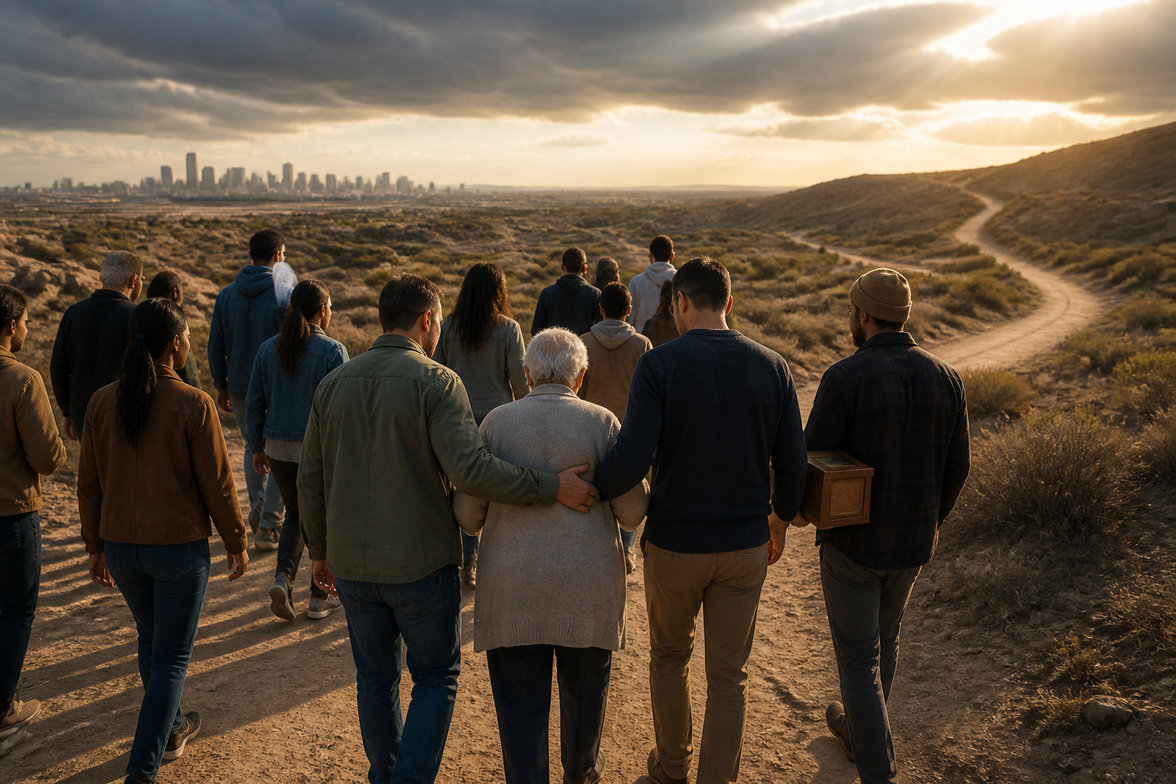
And Moses carries Joseph's bones. The dead travel with the living toward the promise. This is not morbid. It is hope. The covenant spans generations. Joseph, who was thrown into a pit and rose to save nations, will be buried in the land of promise. His story is not over. The bones are a reminder that what was meant for evil, God means for good. The long way is also the way of remembering.
Psalm 114 captures the earth's astonishment at liberation. The sea flees. The Jordan turns back. Mountains skip like rams. Creation itself cannot contain its joy when slaves go free. But notice: the earth trembles not at violence but at presence. "Tremble, O earth, at the presence of the LORD." The power of God is not the power of empire. It is the power that makes the waters part, the hills dance, and the hearts of the oppressed sing.
And then 1 John, with its jarring turn: "We must not be like Cain." The wilderness is not only geography. It is ethics. The people on the long way must learn to love one another, because the desert will kill the solitary. The manna only works when shared. The water from the rock only flows for the community. Cain murdered because his offering was rejected, because he could not bear the vulnerability of being seen and found insufficient. The opposite of Cain is not a better offering. It is laying down one's life.
This is the heart of the Gospel. The long way to freedom is the way of mutual sacrifice. We do not walk out of Egypt alone. We carry the bones of the ancestors. We follow the cloud that is sometimes hard to see. We trust the fire that warms and terrifies. And we love one another, not because it is efficient, but because it is the only way the wilderness does not become a grave.
The pillar of cloud and fire never left its place in front of the people. That is the promise. Not that the journey will be short. But that God will be there, leading, present, refusing to let us go back.
Prayer
O God, you led your people the long way because the short way was a trap.
Give us patience for the wilderness. When we want to turn back to Egypt, lead us forward. When the night is dark, show us the next step. We carry the memory of those who suffered before us. May their witness strengthen us.
Teach us to love one another on this long road. Make us unlike Cain, who could not bear to be known. Make us like you, who laid down your life so we might live together.
The pillar has not left its place. Keep us moving. Keep us free. Amen.
For Today
Where are you tempted to take the shortcut that would actually lead you back to slavery? Whose bones are you carrying toward the promise? And who on this long road needs you to lay down your life - your time, your comfort, your ego - for them today?
-
Trinity Parish Presbyterian Church