Step Into the Water

Reading the Word
From Joshua: Joshua rose early in the morning and set out from Shittim with all the Israelites. They came to the Jordan and camped there before crossing over... The LORD said to Joshua, "This day I will begin to exalt you in the sight of all Israel, so that they may know that I will be with you as I was with Moses."... As soon as the priests who bore the ark of the covenant of the LORD had come up out of the middle of the Jordan, and the soles of the priests' feet touched dry ground, the waters of the Jordan returned to their place and overflowed all its banks. The people came up out of the Jordan on the tenth day of the first month, and they camped in Gilgal on the east border of Jericho. Those twelve stones, which they had taken out of the Jordan, Joshua set up in Gilgal, saying to the Israelites, "When your children ask their parents in time to come, 'What do these stones mean?' then you shall let your children know, 'Israel crossed over this Jordan on dry ground.'"
From Psalm 77: "I cry aloud to God, aloud to God, that he may hear me. In the day of my trouble I seek the Lord; in the night my hand is stretched out without wearying... Will the Lord spurn forever, and never again be favorable? Has his steadfast love ceased forever?... I will call to mind the deeds of the LORD; I will remember your wonders of old. I will meditate on all your work, and muse on your mighty deeds. Your way, O God, is holy. What god is so great as our God? You are the God who works wonders; you have displayed your might among the peoples. With your strong arm you redeemed your people, the descendants of Jacob and Joseph. The waters saw you, O God; the waters saw you and writhed; the very depths trembled."
From Hebrews: "By faith Moses was hidden by his parents for three months after his birth, because they saw that the child was beautiful... By faith Moses, when he was grown up, refused to be called a son of Pharaoh's daughter, choosing rather to share ill-treatment with the people of God than to enjoy the fleeting pleasures of sin... By faith he left Egypt, unafraid of the king's anger... By faith the people crossed the Red Sea as if it were dry land, but the Egyptians, when they attempted to do the same, were drowned. By faith the walls of Jericho fell after they had been encircled for seven days."
Reflection
Forty years in the wilderness. A whole generation buried in the sand. The bones of Joseph carried faithfully across the desert. And now, at the Jordan, the promised land is in sight.
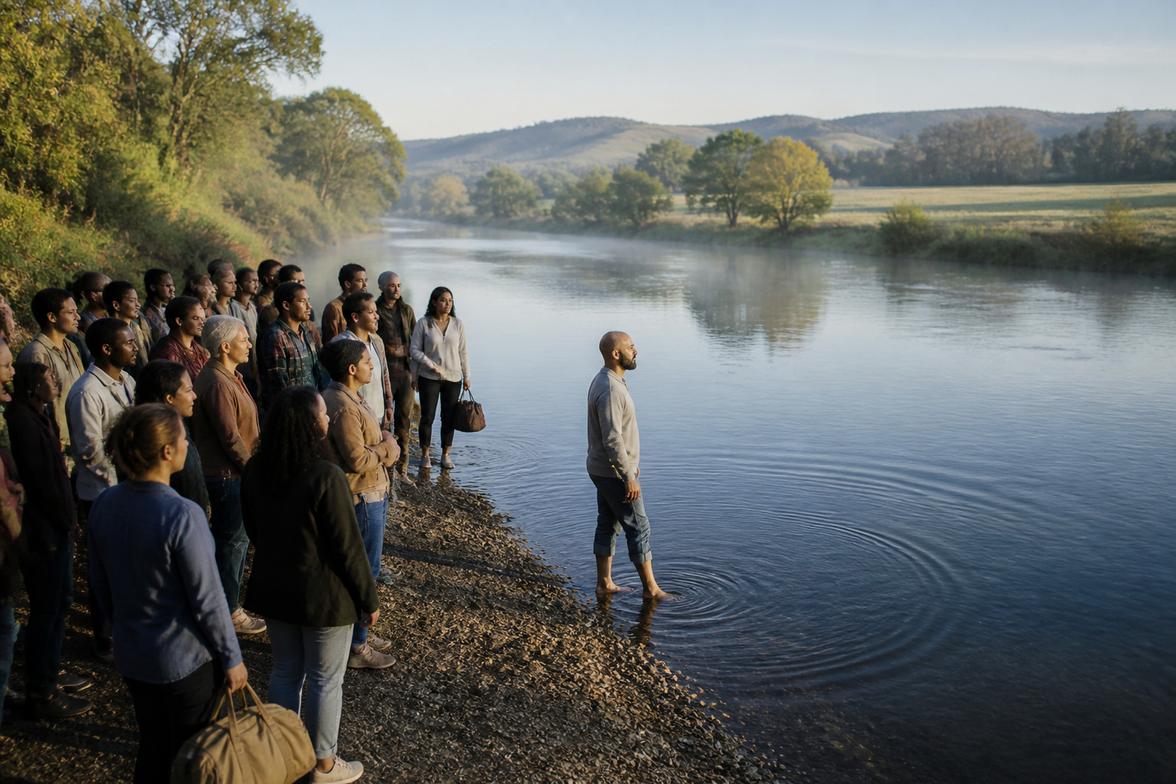
But the river is at flood stage. The waters overflow the banks. The crossing seems impossible. And the priests must step in first; not after the waters part, but before. Faith, in this story, is feet in the water. The Ark of the Covenant goes first, the priests follow, and only then do the waters stand in a heap.
Psalm 77 gives us the prayer that makes this possible. It is a psalm of someone who is drowning in doubt. "Will the Lord spurn forever?" The question is not rebellion. It is exhaustion. And the answer does not come with reasoning. It comes with memory. "I will call to mind the deeds of the LORD." The waters that once parted for Israel are the waters that now seem to block the way. And the psalmist chooses to remember: God has made a way through before.
Hebrews names this as faith. Not faith as positive thinking. Faith as the choice to step into the water because God has been faithful before. Moses' parents hid him because they saw something beautiful. Moses chose solidarity with slaves over comfort in a palace. The people crossed the Red Sea not because they could swim, but because they trusted the God who divides the waters. The walls of Jericho fell not because of military might, but because a people walked in circles, trusting that God's presence was enough.
We are standing at many Jordans. Climate crisis, racial injustice, economic inequality, the collapse of institutions we trusted. The waters are at flood stage. And we are tempted to camp on the near side, to settle for wilderness survival rather than risk the crossing.
But the Ark goes first. The presence of God is not waiting for us on the other side. God is in the water with us. The priests step in, and the waters part. And on the far side, we take twelve stones, one for each tribe, one for each fracture that God has healed into community, and we set them up as a memory. When the children ask, "What do these stones mean?" we tell them: God brought us through. Not around. Not over. Through.
The stones are not monuments to our courage. They are monuments to God's faithfulness in the face of our fear. We are the people who crossed on dry ground. And the waters that once blocked our way become the witness to what God can do.
Prayer
O God, the waters are at flood stage. We stand at the edge of what feels impossible, and we are afraid to get our feet wet. We confess that we would rather camp in the wilderness we know than risk the river we do not.
But you go first. Your presence is in the water before our feet touch it. You have parted waters before, and you will make a way again.
Give us the faith of Moses' parents, who saw beauty where the world saw danger. Give us the faith of Moses, who chose solidarity over comfort. Give us the faith to step in, to walk through, to set up stones of memory for the children who will ask.
What do these stones mean? They mean you are faithful. They mean the waters part. They mean we are home.
In the name of Jesus, who walked through death's deep water and made a way for us, we pray. Amen.
For Today
What river is at flood stage in your life right now? What memory of God's faithfulness can you call to mind when doubt overwhelms you? And what stone of witness do you need to set up, a story, a ritual, a marker, so that those who come after will know what God did?
Blessing
May you step into the water before you see it part. May the God who goes before you keep you in the flood. And may you set up your stones so that the children will ask, the story will live, and the waters will tremble at the presence of God.

-
Trinity Parish Presbyterian Church