On the Mountain, In the Temple

Reading the Word
From Numbers: The LORD said to Moses, "Go up this mountain of the Abarim range and see the land that I have given to the Israelites. When you have seen it, you also shall be gathered to your people, as your brother Aaron was, because you rebelled against my word in the wilderness of Zin... you did not show my holiness before their eyes." Moses said to the LORD, "Let the LORD, the God of the spirits of all flesh, appoint someone over the congregation who shall go out before them and come in before them, who shall lead them out and bring them in, so that the congregation of the LORD may not be like sheep that have no shepherd." And the LORD said to Moses, "Take Joshua son of Nun, a man in whom is the spirit, and lay your hand upon him... commission him in their sight."
From Psalm 78: "Give ear, O my people, to my teaching; incline your ears to the words of my mouth. I will open my mouth in a parable... things that we have heard and known, that our ancestors have told us. We will not hide them from their children; we will tell to the coming generation the glorious deeds of the LORD... He split rocks open in the wilderness, and gave them drink abundantly as from the deep."
From Mark: Again Jesus entered the temple, and as he was teaching, the chief priests and the scribes came to him and said, "By what authority are you doing these things? What is this authority that gives you the right to do them?" Jesus said to them, "I will ask you one question; answer me, and I will tell you by what authority I do these things. Did the baptism of John come from heaven, or was it of human origin? Answer me." They argued with one another, "If we say, 'From heaven,' he will say, 'Why then did you not believe him?' But if we say, 'Of human origin,' they will be afraid of the crowd; for all regarded John as truly a prophet." So they answered Jesus, "We do not know." And Jesus said to them, "Neither will I tell you by what authority I am doing these things."
Reflection
Moses climbs a mountain to see a land he will never enter.
That is one of the most quietly devastating sentences in Scripture. Forty years of wilderness. The plagues, the sea, Sinai, the manna, the quail, the water from the rock, the countless intercessions, the burden of a people who kept asking to go back to Egypt. And now, at the edge of fulfillment, God says: look, but do not go in. You will not be the one who crosses.
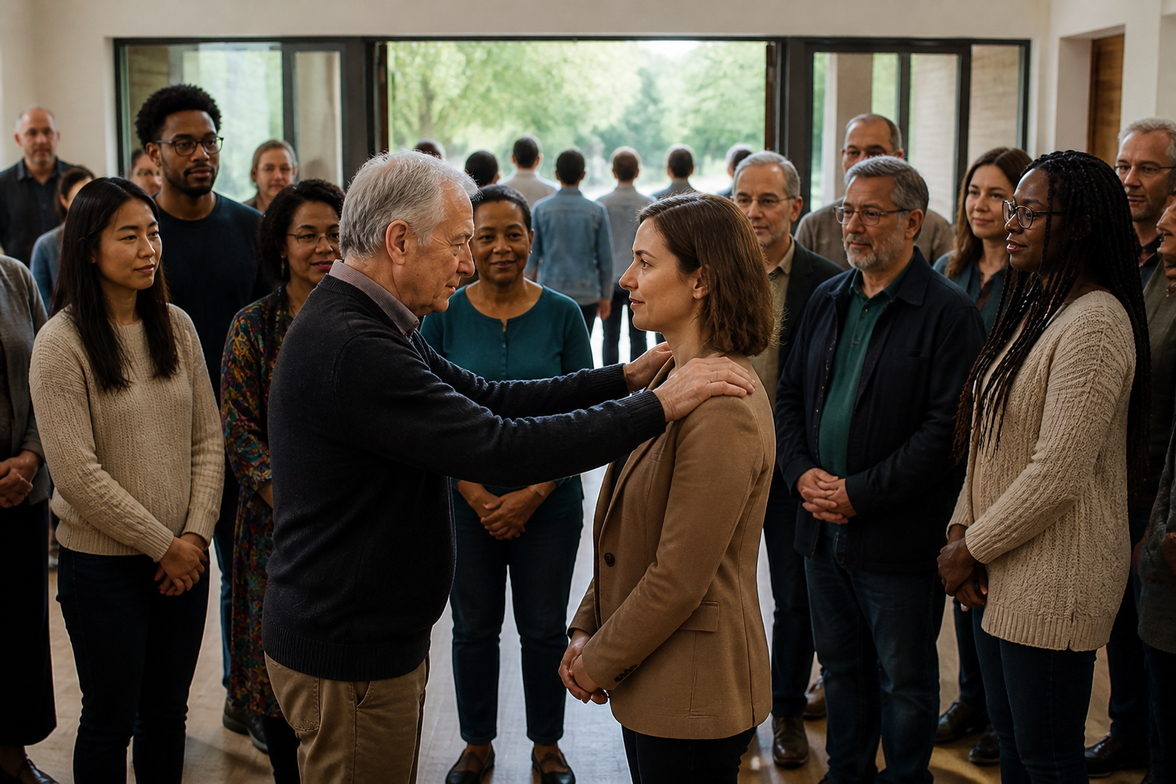
And Moses does not argue. He does not protest that the punishment outweighs the crime. He prays one prayer: "Appoint someone over the congregation, so that the people may not be like sheep that have no shepherd." Moses' last recorded request is not for himself, but for the community. He asks God to send a successor, and God sends Joshua, "a man in whom is the spirit," and Moses lays hands on him in front of everyone.
This is the opposite of what power usually does at the end. Power usually grasps and quite often refuses to name a successor, or it arranges for a weaker heir to make its own legacy look better by comparison. Moses does neither...he commissions the next leader in full public view, transfers the work, and walks up the mountain to die. The story is bigger than the storyteller, and Moses knows it.
Now Mark gives us the men who could not do this.
Jesus is teaching in the temple, and the chief priests and scribes come with a question: "By what authority are you doing these things?" It is not an honest question. It is a trap...a committee ambush, a power play. And Jesus sees it instantly. He answers with a question: "Was the baptism of John from heaven or from men?"
And here is the devastating part. They don't answer because they can't. Not because they lack information; they know exactly what they think about John. But because every possible answer costs them something. Say "from heaven," and they confess their own unbelief. Say "of human origin," and the crowd turns on them. So they choose the third path..."We don't know."
"We don't know" is not humility here, but cowardice dressed as neutrality. It's what institutions say when the truth threatens their standing. And Jesus answers: "Neither will I tell you by what authority I do these things."
Put the two scenes side by side, and you have the whole anatomy of faithful and unfaithful power. Moses, stripped of his own future, spends his last political capital securing the people's future. The temple authorities, secure in their positions, refuse to spend a single ounce of credibility on the truth. One gives away power for the sake of the people. One hoards power at the cost of the truth.
Psalm 78 names why this matters: "We will not hide them from their children; we will tell to the coming generation." The whole project of faith is transmission. The sea, the cloud, the fire, the rock...these wonders belong to a story that must outlive every one of us. Faithfulness is measured by whether the next generation inherits the story, not by whether we kept our position until the end.
For the Church, this is a word for our institution in decline. We have budgets that will not last, buildings that will not last, and many of us will not see, like Moses, promises of God's future that we will not personally inhabit, but only when God takes all things back to God's self in the end. The temptation, then, is to defend what we have, to ambush the prophetic voices, to answer every hard question with a polished "we do not know." The invitation, therefore, is to do what Moses did: bless the Joshua who will go where we cannot, lay hands on the next generation in front of everyone, and trust that the story was never ours to finish, but trust in God to get us all there eventually.
Prayer
O God, we are not the end of the story. Give us the grace of Moses, who saw the land and did not resent it, who prayed for a shepherd instead of a monument, who laid hands on his successor in front of everyone.
Deliver us from the spirit of the temple court, which guarded its position at the cost of the truth, which said "we do not know" when the truth stood in front of them.
Make us tellers of your wonders to the coming generation. May our hands be open when they could grasp. May our last prayers be for the people, not ourselves.
In the name of Jesus, who emptied himself and entrusted the story to fishermen, we pray. Amen.
For Today
What are you tempted to hold onto that belongs to the next generation? Where have you said "we do not know" when you actually knew and it cost you something? And who is the Joshua you could bless in public, trusting that God's story is bigger than your part in it?
Blessing
May you see the land God has promised, even if it is not yours to enter. May you bless the ones who go where you cannot. And may the story of the sea and the rock pass through your hands into hands younger, stronger, and ready for the crossing.

-
Trinity Parish Presbyterian Church