Are You Angry?

Reading the Word
From Jonah: When God saw what the people of Nineveh did, how they turned from their evil ways, God changed his mind about the calamity that he had said he would bring upon them. But this was very displeasing to Jonah, and he became angry. He prayed to the LORD and said, "O LORD! Is not this what I said while I was still in my own country? That is why I fled to Tarshish at the beginning; for I knew that you are a gracious God and merciful, slow to anger, and abounding in steadfast love, and ready to relent from punishing. And now, O LORD, please take my life from me, for it is better for me to die than to live."... Then the LORD God appointed a plant and made it come up over Jonah, to give shade over his head, to save him from his discomfort. Jonah was very happy about the plant. But when dawn came up the next day, God appointed a worm that attacked the plant, so that it withered... But God said to Jonah, "Is it right for you to be angry about the plant?" And he said, "Yes, angry enough to die." But the LORD said, "You are concerned about the plant, for which you did not labor and which you did not grow... And should I not be concerned about Nineveh, that great city, in which there are more than a hundred and twenty thousand persons who do not know their right hand from their left, and also many animals?"
From Psalm 145: "I will extol you, my God and King... Great is the LORD, and greatly to be praised... The LORD is gracious and merciful, slow to anger and abounding in steadfast love. The LORD is good to all, and his compassion is over all that he has made."
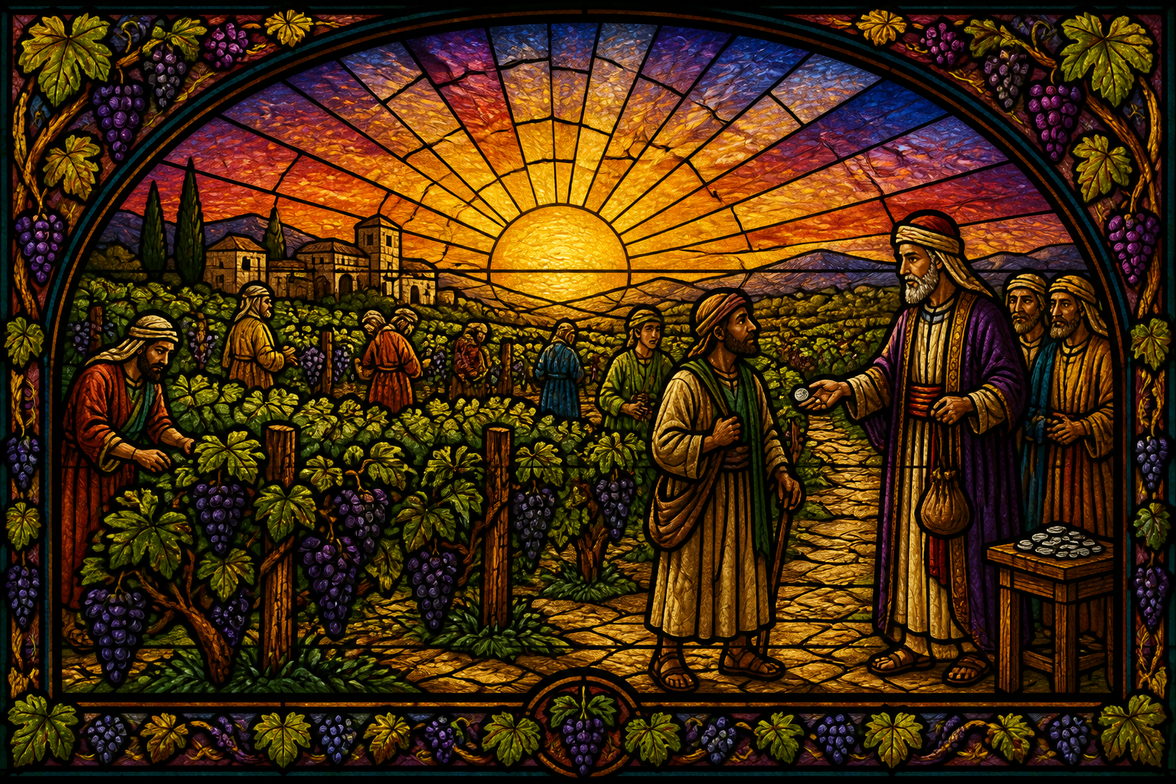
From Matthew: "For the kingdom of heaven is like a landowner who went out early in the morning to hire laborers for his vineyard. After agreeing with the laborers for the usual daily wage, he sent them into his vineyard."... "When those hired about five o'clock came, each of them received the usual daily wage. Now when the first came, they thought they would receive more; but each of them also received the daily wage. And when they received it, they grumbled against the landowner, saying, 'These last worked only one hour, and you have made them equal to us who have borne the burden of the day and the scorching heat.'"... "So the last will be first, and the first will be last."
Reflection
Jonah knew exactly what he was doing.
He did not flee to Tarshish because he was afraid of the Ninevites. He fled because he knew his God. "I knew that you are a gracious God and merciful, slow to anger, and abounding in steadfast love." Jonah's complaint is not that God is unjust. It is that God is too just...too generous! Too forgiving! Too willing to welcome the enemy into the family! Jonah wanted a God who would punish Nineveh. Instead, he got a God who would forgive it.
And when God does forgive, Jonah's response is suicidal. He would rather die than live in a world where the enemy is loved. He sits outside the city in the heat, pouting, while God provides a plant for shade...and then takes it away when Jonah complains about it, and then gets angry again when God takes it away. Jonah is angry about a plant. God says: you care about a plant, but not about a city of a hundred and twenty thousand people and their cattle?
This is the Church's challenge. We say we want mercy, but we want it for the people we already like. We want grace for the oppressed, for the marginalized, for the ones we have already decided are worthy. But what about our enemies? What about the ones who have harmed us? What about the systems and the people who built them? Jonah's God does not ask us to approve of oppression. God asks us to want its transformation more than its destruction. The question is not "Do they deserve mercy?" The question is "Do I want to live in a world where mercy is the last word?"
Matthew's vineyard workers push this further. The ones who worked all day in the scorching heat receive the same wage as the ones who worked one hour. It is not fair. It is grace. And those who have borne the burden are angry, not because they have been shortchanged, but because others have been given what they feel they did not earn. "You have made them equal to us." That is the scandal. Equality feels like theft when you have convinced yourself that your labor earned you more than their need.
The landowner's answer is devastating. "Are you envious because I am generous?" The Greek word for generous is the root of our word "agape," the love that gives without calculation. The landowner is not managing a business; he is embodying the kingdom of heaven. And in the kingdom, the last are not given scraps. They are given the same wage as the first. Not because they deserve it. Because the landowner is good.
Psalm 145 is the hymn that holds both texts. The LORD is gracious and merciful. The LORD is good to all. The compassion is over all that he has made. Not some. All! The cattle of Nineveh, the workers of the eleventh hour, the ones who bore the burden, and the ones who just showed up. The question is never whether God's mercy is wide enough. The question is whether our hearts are wide enough to receive it. And to let others receive it too.
For Christianity, this is our daily work. We are Jonah, sitting outside the city, angry that God loves our enemies. We are the early workers, grumbling that grace is too generous. And we are the ones who must learn that the kingdom of heaven is not a meritocracy. It is a gift. And if we cannot rejoice when the last are made equal, we have not yet understood the gospel we preach.
Prayer
O God, you are gracious and merciful, slow to anger, abounding in steadfast love.
We confess that we are Jonah. We want your mercy for ourselves and your judgment for our enemies. We sit in the heat and pout while you forgive the city we hate.
We confess that we are the early workers. We are angry because your generosity makes everyone equal. We have borne the burden, and we think it should mean something.
But your kingdom is not a business. Your love is not a wage. Your mercy is wide enough for Nineveh and its cattle, for the eleventh-hour worker, for the enemy we cannot bear to love.
Widen our hearts. Soften our anger. Teach us to rejoice when the last are first, when the city is spared, when the wage is grace.
In the name of Jesus, who died for his enemies and rose to welcome us all, we pray. Amen.
For Today
Who is your Nineveh? The person or group you secretly hope God will not forgive? Where are you angry because someone else received grace you think they did not earn? And what would it mean for you to sit in the shade of God's mercy without resenting who else is sitting there?
Blessing
May you know that God's compassion is over all that God has made. May the last become first in your heart, and the first become last in your pride. And may you find joy in a kingdom where grace is the only wage, and mercy is the only measure.

-
Trinity Parish Presbyterian Church