The Return to the Messy Middle

Date: Friday, April 24, 2026
Lectionary Cycle: Year A, Easter Season
Source: Vanderbilt Revised Common Lectionary
Scripture Readings
- Old Testament: Exodus 3:16-22; 4:18-20 (Moses’ commission and return to Egypt)
- Psalm: Psalm 23 (The Good Shepherd)
- Epistle: 1 Peter 2:13-17 (Living as free people in community)
Reflection: Engaging the Complexities of Life
In the narrative of Exodus, Moses is found in the wilderness, a place of relative safety and isolation following his flight from Egypt. However, the divine encounter at the burning bush disrupts this peace. The command is not to remain in the quiet of the desert but to return to the heart of the conflict: “Go and assemble the elders of Israel…” (Exodus 3:16). By the following chapter, Moses is navigating the practicalities of this call, packing his family onto a donkey and heading back toward the broken systems and heavy burdens of a people in despair.
The "wilderness" is often a tempting place to stay. It offers an escape from complicated relationships and the anxieties of the world. Today, many feel a similar sense of abandonment or hopelessness. Younger generations often view global polarization with a sense of dread, wondering if stability is a thing of the past. Simultaneously, older adults frequently struggle with isolation, mourning the loss of the vibrant, close-knit community structures of previous decades.
Yet, scripture suggests that God meets us precisely in the "messy middle" of human interaction. Moses was not sent to solve every problem in isolation; he was instructed to gather the elders and lean on his community.
This theme is reinforced in the Epistle of Peter, which calls believers to "live as free people" who "love the family of believers." Even the comforting imagery of Psalm 23 acknowledges this reality. The Shepherd prepares a table not in a vacuum, but "in the presence of enemies." Divine restoration often happens right in the center of our anxieties and turbulent daily lives.
Stepping back into the fray, whether by listening to a discouraged youth or sitting with the isolated and marginalized, is an act of courage. It is a participation in the work of the Shepherd, seeking to restore the soul of the community.
Visio Divina: Sacred Art
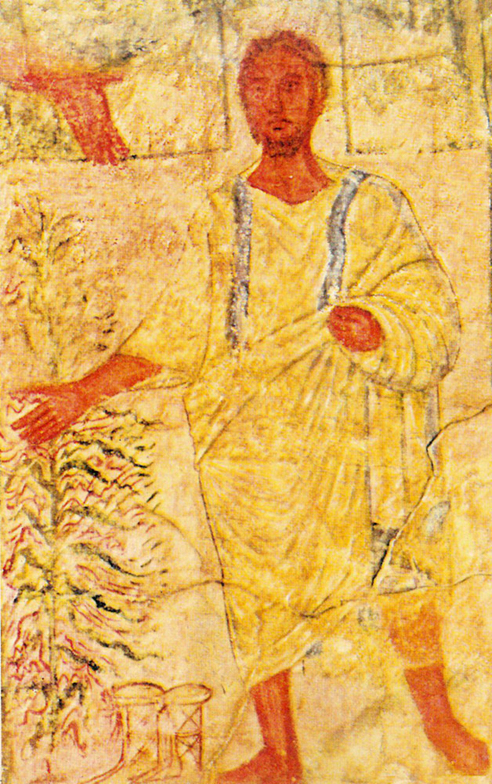
Artwork: Moses and the Burning Bush
Artist: Unknown (Fresco from Dura-Europos Synagogue, Syria)
Date: ca. 250 CE
Resource: Vanderbilt Digital Library
Meditation:
This ancient fresco, one of the oldest preserved synagogue paintings, was created within a bustling and often hostile cultural center. It served to hold a community together by reminding them of their history and God’s presence in exile.
Consider the following:
- Holy Ground in the Ordinary: Moses was instructed to remove his shoes on holy ground. Where might "holy ground" exist in your ordinary, perhaps even difficult, interactions today?
- The Reaching Hand: The fresco depicts the hand of God reaching into the frame. Where do you see a prompt to reconnect with someone who feels isolated?
- Visualizing Hope: How can you help create a "picture" of hope for someone else today, offering the same sense of community this fresco provided for its ancient viewers?
Prayer
Good Shepherd, you know our names and the places where we are tempted to hide. Give us the listening ear to hear the cries of those around us...the young who are anxious for their future and the old who are lonely for connection. Grant us the courage of Moses to step back into the complexities of life, trusting that your goodness and mercy follow us every step of the way. May we be instruments of your gathering love. In the name of the Risen Christ, Amen.
-
Trinity Parish Presbyterian Church