She Took the Tambourine

Yesterday was filled with lilies and alleluias. Today is Monday. For many, the day after a great celebration carries a particular quiet. The guests have departed, the flowers begin to droop, and the demands of the week reassert themselves—laundry, emails, and the return to routine. In these ordinary moments, it can feel as though Easter is something that happened in the past tense—beautiful, but finished. Today’s readings push back against that sentiment, offering a faith that is very much alive in the "after."
What the Water Remembers
The passage from Exodus finds the Israelites at the edge of the Red Sea with Pharaoh’s army closing in. Terrified, they turn on Moses, asking if they were brought into the wilderness simply to die. This reaction is deeply human. Having spent lifetimes in captivity, they understood how to survive slavery; they did not yet know how to trust a God leading them through an impossible obstacle toward the unknown.
Freedom can often feel more daunting than familiar chains. Whether it is leaving behind unhealthy behaviors, abandoning a limiting pattern of thought, or moving past a long-held grief, the "other side" can feel precarious. Yet, the waters part, and the crossing happens nonetheless.
Miriam’s Song of Liberation
After the crossing, a remarkable moment occurs in the margins of the text. It is not a formal ceremony, but a spontaneous act of leadership:
"Then the prophet Miriam, Aaron's sister, took a tambourine in her hand; and all the women went out after her with tambourines and with dancing. And Miriam sang to them: 'Sing to the Lord, for he has triumphed gloriously...'" (Exodus 15:20-21)
Miriam had carried that tambourine out of Egypt. She didn’t wait for a programmed transition or official permission; she picked it up and led. While Moses offered a formal song, Miriam provided the embodied, communal response. Easter does not end at the empty tomb; it continues when we choose to pick up the tambourine and move toward joy.
The Work of Renewal
In Colossians 3, Paul discusses the discipline required to live in this new life. He is direct: crossing the water means leaving certain things behind. He lists behaviors such as anger, malice, slander, and abusive language. These are not abstract vices; they are relational poisons. Paul suggests that because we have "crossed over," the old patterns of contempt and cruelty no longer fit our identity. In this renewal, traditional divisions—social, ethnic, and economic—dissolve because Christ is "all and in all."
Today is the Day
Psalm 118 provides the heartbeat of the Easter season: "This is the day that the Lord has made; let us rejoice and be glad in it." This verse does not refer only to the Sunday of the Resurrection, but to this specific, ordinary Monday. The resurrection reframes every day that follows, inviting us to see God’s steadfast love in the present moment.
Associated Artwork
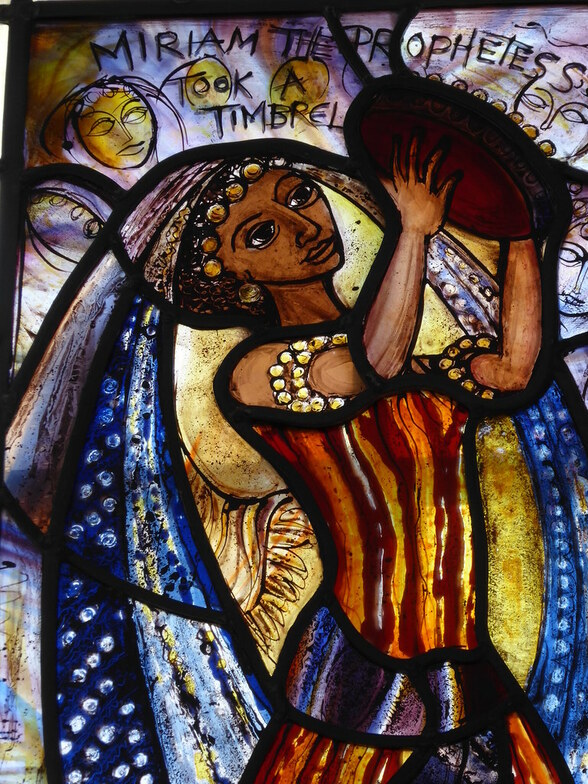
Title: Prophet Miriam
Artist: Pippa Blackall (2008)
Medium: Stained Glass, St Edmundsbury Cathedral, UK
This contemporary stained glass window depicts Miriam praising God after the Red Sea crossing. The medium of stained glass serves as a metaphor for Easter week: light passing through from the other side, transforming everything it touches.
Reflection Questions
- The Tambourine: Is there a "crossing" in your life—a hardship you have moved through—that you haven't fully celebrated? What would it look like to mark that moment with genuine joy today?
- The Relational List: Which of the behaviors Paul mentions (anger, malice, slander, or abusive language) is hardest for you to leave on the other side of the water? How might your relationships change if you let it go?
- The Present Moment: How would your perspective shift today if you viewed this specific Monday as "the day the Lord has made" rather than just a return to the grind?
Prayer for Easter Monday
God of the crossing,
You did not bring us through the water only to leave us standing on the shore.
Teach us to pick up our tambourines.
Give us Miriam’s courage to begin the song before the crowd joins in,
and to lead others into a joy we are still learning ourselves.
Where we are still holding on to old bitterness and the walls we have built,
let the waters close over those things.
Help us walk into this ordinary Monday as people transformed by something extraordinary.
For your steadfast love endures forever.
Amen.

-
Trinity Parish Presbyterian Church