Another Easter Devotional

Daily Devotional - Easter Sunday
Date: April 5, 2026
Lectionary Cycle: Year A
Occasion: Resurrection of the Lord
Readings: Acts 10:34-43 | Psalm 118:1-2, 14-24 | Colossians 3:1-4 | John 20:1-18
Called by Name
The Reality of the Dark
It is still dark when Mary Magdalene arrives at the tomb. John’s Gospel emphasizes this detail—not dawn, not the first light of morning, but still dark. Mary does not come expecting a miracle; she comes because grief often pulls us back to the place where we last held what we lost. Whether it is driving past a former home or standing in a quiet room in the middle of the night, many understand the impulse to stay near the site of a profound loss.
In this moment, Mary finds that everything has fallen open.
The Stranger in the Garden
Upon finding the stone moved, Peter and the "beloved disciple" run to the tomb, observe the scene, and return home. The text notes they "believed," yet did not yet fully understand. While the disciples process the event by taking action or seeking facts, Mary remains. She stands outside the tomb and weeps.
In her grief, she encounters a man she assumes to be the gardener. Blinded by sorrow, she asks him where the body has been taken, still looking for something to care for in death. Then, the man speaks a single word: "Mary."
The Moment of Recognition
There is a specific power in hearing one’s name spoken by someone who truly knows them. It is the sound of a parent finding a lost child or a long-lost friend recognizing a face in a crowd. This recognition is the heart of the resurrection. It is not merely a theological argument or a historical hypothesis; it is a deeply personal, relational encounter.
The resurrection is a cosmic event that pivots history, but in John’s narrative, it begins with a woman alone in a garden being called by name. As Peter later declares in Acts 10, "God shows no partiality." The resurrection is not reserved for an inner circle; it is for the one standing in the dark, weeping, and searching.
The Commission
Jesus does not tell Mary to rest or retreat. Instead, he gives her a mission: "Go to my brothers and sisters and tell them." Mary Magdalene, the one who came to anoint a corpse, becomes the first witness and the first preacher of the resurrection.
Her testimony is simple and direct: "I have seen the Lord." This is the essence of resurrection faith—not an abstract set of beliefs, but a living encounter carried into the world.
Scripture Perspectives
Colossians 3:1-4 – The Hidden Life
Paul writes, "You have died, and your life is hidden with Christ in God." This suggests that the truest version of ourselves is tucked safely within the resurrection. While we often live based on what is visible—productivity, status, or external success—there is a deeper life that death cannot touch. Easter is an invitation to belong to a reality that the tomb could not hold.
Psalm 118 – This Is the Day
"This is the day that the LORD has made; let us rejoice and be glad in it." This Psalm was written from a context of hardship and struggle. It acknowledges a world where people are "pushed hard" and "surrounded," yet it insists on joy. Easter does not pretend that darkness doesn't exist; it simply asserts that the day has come, the name has been spoken, and the one who was dead is now present.
Reflection and Application
- Identifying the "Tomb": Where are you still "standing outside the tomb," grieving a loss or waiting for a change? How can you bring that grief to the risen Christ today?
- The Power of a Name: Is there someone in your life who needs to be seen or heard today? How can you practice "resurrection" by reaching out to them?
- Living the Hidden Life: What would it look like today to live as if your truest self is "hidden with Christ in God," secure regardless of external circumstances?
A Prayer for Easter Morning
Lord of the garden, Lord of the morning—
You called Mary by name, and she knew you.
Speak our names today—in the quiet, in the chaos, and in the ordinary.
Where we are weeping, meet us there.
Where we have gone looking in the wrong places, turn us around.
Give us the courage to go and tell others of your presence, saying as simply and boldly as Mary did:
"I have seen the Lord."
Amen.
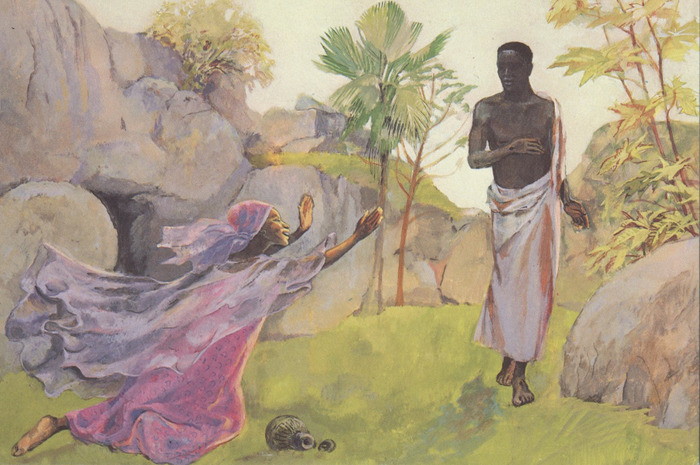
Featured Artwork
"Easter - Christ appears to Mary"
Artist: JESUS MAFA, 1973
Origin: Cameroon, Africa
This painting, created by the JESUS MAFA community in Cameroon, depicts the moment of recognition between Mary and Jesus. Mary is shown on her knees in a posture of joy and reaching, while Jesus radiates peace. The image captures the infectious happiness of the encounter, illustrating the belief that death does not have the final word.
Image courtesy of Art in the Christian Tradition, Vanderbilt Divinity Library.
Lectionary readings sourced from the Vanderbilt Revised Common Lectionary. Scripture quotations are from the New Revised Standard Version (NRSV).

-
Trinity Parish Presbyterian Church