A Sign Before the Step

Daily Devotional: Monday, April 13, 2026
Year A | Easter Season — Monday of the Third Week of Easter
Scripture Readings
- Psalm 114: A celebration of God’s power in the Exodus.
- Judges 6:36-40: Gideon’s request for a sign through the fleece.
- 1 Corinthians 15:12-20: Paul’s defense of the Resurrection as the foundation of faith.
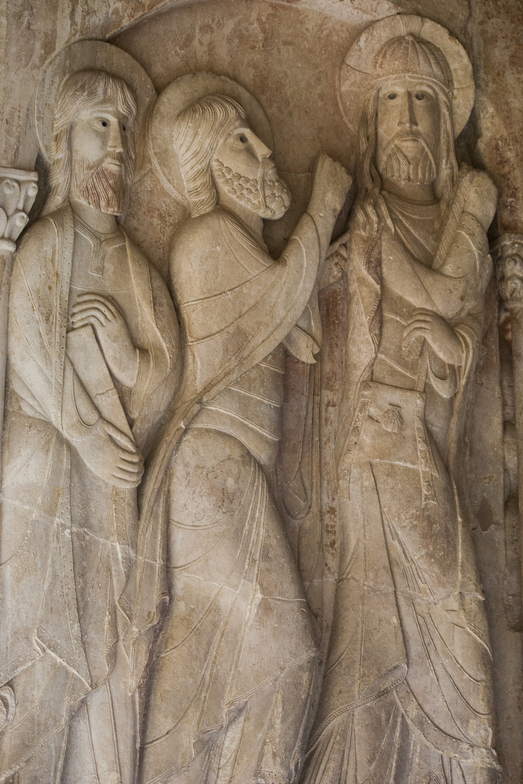
Featured Artwork
Title: Christ and the Disciples Walking to Emmaus
Details: 12th-century stone relief, Monasterio de Santo Domingo de Silos, Spain.
Source: Vanderbilt Divinity Library, Art in the Christian Tradition
In this medieval stone carving, three figures journey together. The risen Christ walks incognito beside his disciples—companions on a path they have not yet fully understood. His posture is steady, while theirs carries the weight of those walking toward a revelation they haven't quite seen yet. This image captures the tension between the physical presence of the divine and the human struggle to recognize it.
Reflection: The Courage to Ask
Most people have, at some point, prayed a version of Gideon’s prayer. It rarely sounds like a formal liturgy; instead, it often sounds like a weary plea at 2:00 AM: "God, if this is really what I’m supposed to do, just open a door. Give me something."
Gideon was called to a terrifying task. Coming from the weakest clan and being the least significant member of his family, he was asked to lead a military campaign against overwhelming odds. His response was reasonable: he asked for confirmation. Even after fire consumed an offering on a rock, he asked for the test of the fleece. Not once, but twice.
What is most striking in this account is God’s response. There is no rebuke or exasperation. God does not demand immediate, blind obedience; instead, God meets Gideon in his fear and provides the confirmation he needs. This reveals a deeply relational God who understands the human need for certainty before taking a leap of faith.
In 2026, this resonates with the "in-between" moments of modern life. It speaks to:
- The parent...preparing for a difficult but necessary conversation with a child.
- The individual...weighing a significant career change or relocation.
- The caregiver...wondering if their silent sacrifices are seen or valued.
- The person facing a health uncertainty, looking for a reason to hope.
Hesitation is not a disqualification from faith. Gideon’s story suggests that the need for reassurance is not a spiritual character flaw, but a part of a transparent relationship with the Creator.
While Gideon sought local signs, the Apostle Paul points the Corinthian church toward the "ultimate sign." Paul argues that the Resurrection is not an optional add-on to faith; it is the load-bearing wall. He is blunt: if Christ has not been raised, faith is futile.
However, Paul pivots to a firm declaration: "In fact, Christ has been raised." This historical and spiritual anchor provides the confidence that allows us to move forward. If the ultimate question of death has been answered, then the smaller uncertainties of our daily lives can be navigated with courage.
Psalm 114 adds a layer of cosmic joy to this theme. It describes the sea fleeing and mountains skipping like rams at the presence of God. It asks rhetorically, "What ails you, O sea, that you fled?" It invites us into a posture of confidence. If the natural world recognizes its Creator, we too can find stability in the knowledge that the God who parts the waters and empties the tomb is the same God walking beside us on our own "Emmaus roads."
Personal Reflection Questions
- The Honest Request: Is there a situation where you are currently waiting for a "sign" before moving forward? How would it feel to bring that request to God without shame?
- The Patience of God: How does knowing that God did not rebuke Gideon for his doubt change the way you view your own moments of uncertainty?
- The "In Fact" of Faith: How does the certainty of the Resurrection change your perspective on a specific, uncertain decision you are facing this week?
- Recognizing the Presence: In what ways might God be walking "incognito" beside you right now, even if you haven't recognized the "sign" yet?
Closing Prayer
Lord of the fleece and the empty tomb,
Meet us in the places where we hesitate.
Where we are called to risk—
in our relationships, our work, and our commitments—
grant us the confirmation we need.
Where we are worn down, remind us that the power
that raised Christ from the dead is at work in us today.
Thank you for your patience with our questions
and your presence in our uncertainty.
You have answered before, and we trust you will answer again.
Amen.
-
Trinity Parish Presbyterian Church